
The global skincare industry across Southeast Asia is undergoing a permanent regulatory and biochemical shift. Driven by aggressive enforcement from health authorities like Malaysia’s National Pharmaceutical Regulatory Agency (NPRA) and Indonesia’s BPOM, the era of harsh, toxic skin “whitening” creams is officially over. Brand owners, dermatologists, and modern consumers have turned their backs on aggressive bleaching agents that compromise skin barrier health for temporary results.
However, consumer demand for effective skin brightening solutions remains at an all-time high. Tropical sun exposure, high ambient humidity, post-acne inflammation, and hormonal fluctuations make dark spots, melasma, and uneven skin tone primary concerns for consumers across Malaysia, Singapore, and Indonesia.
This shift creates a lucrative commercial opportunity for beauty brand founders, aesthetic clinic lines, and personal care entrepreneurs. Modern consumers actively seek safe, barrier-supportive, and clinically proven skin brightening products. To capture this high-intent market demand without risking regulatory bans or product recalls, brand owners must understand modern active chemistry, multi-pathway melanogenesis inhibition, and strict Shariah manufacturing standards.
Located in Kajang, Selangor, the contract manufacturing specialists at CL Cosmetic Industries have created this comprehensive guide. Below is the strategic blueprint for formulating, registering, and launching a high-margin, NPRA-compliant skin brightening skincare line in 2026.
Skin Brightening vs Skin Whitening: The 2026 Paradigm Shift
Understanding the fundamental difference between traditional skin whitening and modern skin brightening is essential for product positioning, consumer trust, and regulatory compliance.
[Traditional Skin Whitening] ➔ Aggressive bleaching (Mercury/Hydroquinone) ➔ Destroys melanocytes & disrupts skin barrier
       VS
[Modern Skin Brightening] ➔ Multi-pathway inhibition (Tranexamic Acid/Arbutin) ➔ Regulates melanin & strengthens lipid barrier
1. Mechanism of Action
Traditional skin whitening focused on aggressive bleaching, often attempting to strip natural pigment entirely or destroy melanocyte cells using harsh chemical agents. In contrast, modern skin brightening focuses on melanogenesis regulation. It gently inhibits excess melanin synthesis, blocks melanosome transfer, and restores natural radiance without altering baseline genetic skin tone.
2. Ingredient Safety and Toxicity
Legacy whitening creams frequently relied on hazardous compounds like mercury salts, high-dose corticosteroids, and hydroquinone. Today, advanced skin brightening formulations utilize clinically validated, non-toxic actives like Tranexamic Acid, Alpha Arbutin, Niacinamide, and oil-soluble Vitamin C derivatives that nourish the skin barrier while fading discoloration.
3. Long-Term Skin Barrier Impact
Harsh skin whitening products degrade the stratum corneum, causing photosensitivity, severe redness, and exogenous ochronosis (permanent blue-black tissue staining). Conversely, a well-engineered skin brightening serum integrates ceramides, squalane, and soothing botanicals to reinforce the skin’s protective lipid mantle during daily wear.
Brand owners who align their product messaging with safe skin brightening satisfy regulatory demands and build long-term consumer loyalty. You can explore market data on these consumer shifts in our CL Cosmetic Beauty Insights Hub.
Why Safe Skin Brightening Demands Purpose-Built OEM R&D
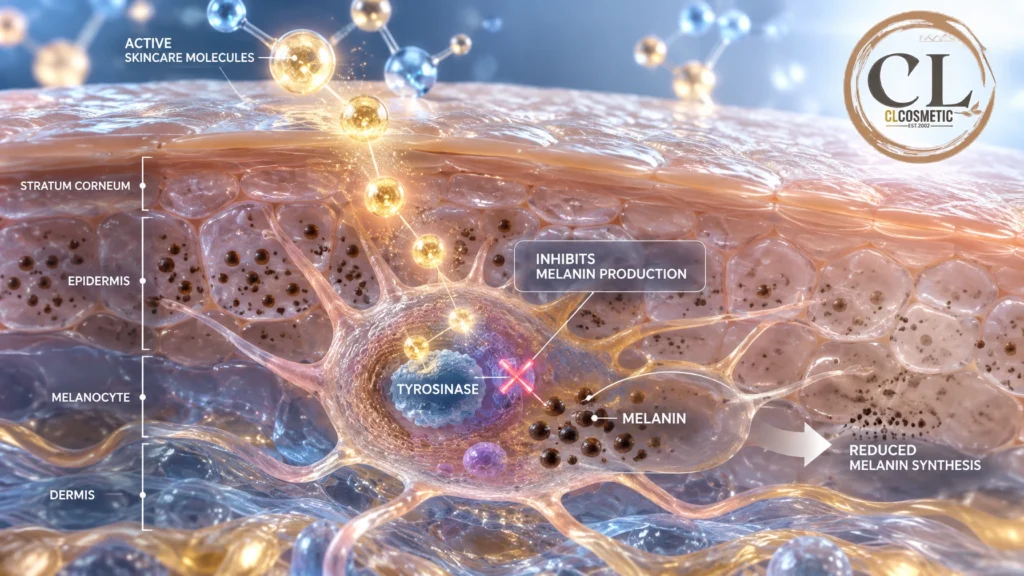
In conventional personal care manufacturing, formulating a standard hydrating cleanser or basic moisturizer is relatively simple. Developing effective skin brightening cosmetics, however, requires a much deeper level of cosmetic chemistry. Melanogenesis involves complex enzymatic pathways, cellular messenger cascades, and environmental triggers.
Historically, uncertified manufacturers used illegal shortcuts to force fast bleaching results:
- Mercury Salts: Inhibit melanin by replacing copper in the tyrosinase enzyme, but cause systemic organ damage, neurological toxicity, and kidney failure. According to official health guidance from the World Health Organization (WHO), mercury in skin lightening products represents a major global public health hazard.
- Hydroquinone: A potent depigmenting drug that destroys melanocyte cells. Hydroquinone is strictly classified as a prescription-only pharmaceutical under the ASEAN Cosmetic Directive (ACD) Annex II list of banned cosmetic substances. It is prohibited in over-the-counter cosmetics due to severe risks of permanent ochronosis.
- Topical Corticosteroids: Illegally added to suppress severe skin inflammation caused by harsh bleaching agents, leading to skin atrophy, broken capillary vessels, and chronic acne flare-ups.
Distributing products with trace amounts of these banned substances leads to immediate NPRA public bans, product confiscation, heavy legal penalties, and permanent brand destruction.
Partnering with a specialized Halal cosmetic OEM manufacturer eliminates these commercial risks. By replacing hazardous chemicals with safe, certified skin brightening actives, an experienced contract manufacturer helps you build a high-performance skincare line that delivers visible, lasting results.
Tranexamic Acid vs Hydroquinone: Choosing Safe Clinical Efficacy
When designing a high-potency hyperpigmentation product, brand owners often compare pharmaceutical hydroquinone against modern, non-toxic alternatives like Tranexamic Acid.
| Formulation Feature | Hydroquinone (Prescription Only) | Tranexamic Acid (Cosmetic Safe) |
| Regulatory Status | Banned in OTC cosmetics (ASEAN ACD Annex II) | 100% Approved for OTC cosmetics |
| Primary Mechanism | Cytotoxic to melanocyte cells; destroys pigment | Inhibits plasminogen/plasmin inflammatory pathway |
| Side Effects | High risk of ochronosis, severe stinging & redness | Non-irritating, safe for sensitive & rosacea skin |
| Photosensitivity | Causes severe UV sensitivity | Zero photosensitivity; can be worn during daytime |
| Long-Term Safety | Limited to 3 months maximum usage | Safe for continuous long-term daily application |
Originally used in medicine to manage blood clotting, Tranexamic Acid has become a standout ingredient in professional skin brightening serums. When UV rays or hormonal shifts stress keratinocyte cells, they release plasminogen, which triggers melanocytes to produce dark pigment.
Clinical research indexed on the National Center for Biotechnology Information (NCBI) confirms that topical Tranexamic Acid (2.0% to 3.0%) blocks this inflammatory signal at the surface, effectively treating stubborn melasma and post-inflammatory erythema (red acne scars) without damaging surrounding tissue.
To maximize formula performance, OEM chemists pair Tranexamic Acid with Alpha Arbutin (1.5% to 2.0%). Alpha Arbutin acts as a safe hydroquinone-glucoside derivative, slowly releasing active compounds to competitively inhibit the tyrosinase enzyme. Combining these two actives creates a powerful skin brightening system that stops pigment formation from two distinct biological angles.
Alpha Arbutin vs Kojic Acid: Selecting the Right Tyrosinase Inhibitor
Another key decision in skin brightening formulation is choosing between Alpha Arbutin and Kojic Acid derivatives. Both target the tyrosinase enzyme, but their stability profiles and skin compatibility vary significantly.
1. Alpha Arbutin
Alpha Arbutin is an exceptionally stable, water-soluble active that works reliably within a skin-friendly pH range of 4.5 to 6.5. It delivers steady skin brightening benefits without triggering stinging or localized redness, making it an excellent choice for daily serums and lightweight essences.
2. Kojic Acid Dipalmitate (KAD)
Standard Kojic Acid (a byproduct of fermented rice and fungi) is an effective brightener, but it oxidizes rapidly in water-based creams, turning the product dark brown within weeks. To overcome this stability issue, advanced contract manufacturers utilize Kojic Acid Dipalmitate (KAD), an esterified derivative. KAD offers excellent resistance to light, heat, and oxygen degradation while delivering strong skin-brightening efficacy in cream emulsions.
By analyzing your target packaging, formula texture, and price point, an experienced OEM chemist will select or combine these actives to ensure optimal product shelf life and performance. Discover how we integrate these advanced ingredients in our guide to Biotech Actives: Strategic Integration for Brand Differentiation in Manufacturing.
L-Ascorbic Acid vs THD Ascorbate: Solving the Oxidation Problem
Vitamin C is one of the most widely searched terms in global personal care. However, traditional pure Vitamin C (L-Ascorbic Acid) presents major manufacturing challenges in water-based formulas.
[L-Ascorbic Acid (Water-Soluble)] ➔ Highly Unstable ➔ Rapid Oxidation (Turns Brown) ➔ Low Lipid Penetration
       VS
[THD Ascorbate (Oil-Soluble)] ➔ Exceptional Stability ➔ Zero Oxidation in Formula ➔ 50x Deeper Lipid Penetration
- L-Ascorbic Acid: Requires a very low, acidic pH (below 3.5) to remain active, which often causes stinging and skin barrier disruption. It degrades rapidly when exposed to air, light, or water, losing its skin brightening potency.
- Tetrahexyldecyl Ascorbate (THD Ascorbate): An advanced, oil-soluble Vitamin C derivative. THD Ascorbate remains stable at a neutral pH and penetrates the skin’s lipid barrier up to 50 times more effectively than L-Ascorbic Acid. Once inside the dermis, it converts to pure Vitamin C, neutralizing free radicals, boosting collagen synthesis, and accelerating skin brightening without oxidizing in the container.
Using stabilized THD Ascorbate allows your brand to deliver a high-potency, long-lasting product that retains its original color, scent, and efficacy throughout its shelf life.
Niacinamide and Ceramides: Melanosome Blocking & Barrier Support
Fading dark spots effectively requires protecting the skin barrier. If a skin brightening formula causes peeling, dryness, or irritation, the skin responds by producing excess melanin as a defense mechanism, worsening discoloration.
To ensure your skin brightening line is safe for daily use on sensitive skin, your contract manufacturer should combine active brighteners with soothing, barrier-repairing compounds. We detail these protective standards in our report on Barrier-First Creams: Ingredient Standards.
Niacinamide (Vitamin B3 – 3.0% to 5.0%)
While ingredients like Alpha Arbutin reduce melanin synthesis, Niacinamide prevents existing melanin from reaching the skin surface. A study published in the British Journal of Dermatology demonstrated that Niacinamide inhibits the transfer of melanosomes (pigment packets) from melanocytes into surrounding keratinocyte cells by up to 68%. Niacinamide also regulates excess oil production and tightens enlarged pores, making it ideal for tropical climates.
Multi-Ceramide Complex (Ceramides NP, AP, EOP)
Adding skin-identical ceramides to your skin brightening creams or night serums restores the intercellular lipid matrix. Ceramides prevent transepidermal water loss (TEWL) and shield sensitive skin from environmental stressors, allowing active brighteners to work efficiently without triggering irritation.
Liposomal Delivery Systems for Deep Dermal Penetration
Melanocyte cells reside in the stratum basale, the deepest layer of the epidermis. If a skin brightening product merely sits on the surface layer of dead cells (stratum corneum), its active ingredients will evaporate or rub off before reaching target receptors.
To achieve superior clinical results, advanced manufacturing facilities utilize liposomal delivery technology, a process similar to the bio-delivery systems described in our analysis of Polynucleotides and PDRN: Technical Deep-Dive.
[Hydrophilic Core] ➔ Holds Water-Soluble Actives (Tranexamic Acid / Niacinamide)
       │
[Lipid Bilayer Shell] ➔ Fuses with Dermal Cell Membranes for Deep Delivery
       │
[Lipophilic Phase] ➔ Holds Oil-Soluble Actives (THD Ascorbate / Squalane)
Liposomes are microscopic, spherical vesicles made of natural phospholipids that match the structure of human cell membranes. When applied, these liposomal spheres encapsulate both water-soluble and oil-soluble brighteners, transporting them through the outer epidermal layers directly to the basal layer.
This targeted delivery system allows your skin brightening products to achieve excellent clinical results at lower active concentrations, minimizing skin irritation while maximizing product performance.
Securing Full JAKIM Halal and NPRA Compliance
For beauty brands targeting primary consumer markets across Malaysia, Indonesia, Singapore, and the GCC, Halal certification is essential for commercial growth. Muslim consumers actively check ingredient origin and certification logos before purchasing skincare products.
Many conventional formulations use animal-derived stearic acid, non-Halal squalene, or denatured ethyl alcohol as solubilizers. A certified OEM replaces these problematic ingredients with fully compliant alternatives, as discussed in our Essential Guide to Halal-Certified OEM Partnerships for Beauty Brands.
- 100% Olive-Derived Squalane: Replaces animal-derived squalene, offering a lightweight, non-greasy lipid carrier that mirrors natural skin sebum.
- Corn-Derived Bio-Propanediol: Replaces ethyl alcohol, serving as a bio-based solvent that dissolves crystalline active powders without drying the skin or violating Shariah standards.
- Automated Cleanroom Processing: Production takes place in GMP-certified cleanrooms, where stainless steel mixing vessels undergo certified Sertu sanitization to guarantee zero cross-contamination.
Our regulatory affairs department manages the complete filing process. We compile the Product Information File (PIF), conduct thermal stability testing, and submit all documentation directly to the NPRA Quest3+ portal to secure legal product notification numbers before commercial filling begins.
Active Ingredient Matrix for Skin Brightening Formulations
To help brand owners select the ideal active combination for their target price point and product claims, the comparison matrix below breaks down key ingredient attributes:
| Active Ingredient | Primary Target Mechanism | Formula Stability Level | Recommended Usage % | Ideal Product Format | Halal & Regulatory Status |
| Tranexamic Acid | Inhibits plasminogen pathway & UV inflammatory cascades | Exceptional | 2.0% – 3.0% | Water-based Serums & Spot Treatments | Synthetic origin; 100% Halal-compliant |
| Alpha Arbutin | Competitively inhibits Tyrosinase enzyme | Moderate (Requires pH 4.5-6.5) | 1.5% – 2.0% | Brightening Essence & Night Creams | Botanical/Synthetic; Halal certified |
| THD Ascorbate | Neutralizes free radicals & boosts collagen | High (Oil-soluble) | 1.0% – 3.0% | Facial Oils, Emulsions & Rich Creams | Synthetic derivative; Halal compliant |
| Niacinamide (B3) | Blocks melanosome transfer to keratinocytes | Exceptional | 3.0% – 5.0% | All Formulations (Cleansers to Creams) | Synthetic B3; Halal certified |
| Kojic Acid Dipalmitate | Suppresses Tyrosinase via copper chelation | High (Esterified form) | 1.0% – 2.0% | Pigment Correction Creams & Body Lotions | Fungal derivative; Halal certified |
| Glutathione (Reduced) | Direct free radical scavenger & melanin switching | Moderate (Sensitive to air) | 0.5% – 1.0% | Encapsulated Serums & Ampoules | Bio-fermentation; Halal certified |
In-House R&D vs OEM Manufacturing: Commercial ROI Breakdown
Building an in-house laboratory and cleanroom facility requires millions of ringgit in capital expenditure, specialized technical staff, and continuous regulatory oversight. Attempting to mix products in uncertified facilities exposes your business to contamination risks, unstable formulas, and regulatory shutdowns.
| Commercial Metric | In-House Facility Setup | CL Cosmetic OEM Partnership |
| Initial Capital Expenditure | High (RM 1.5M – RM 3.0M+) | Low (Flexible starting order tiers) |
| Regulatory Filing Speed | Slow (Complex internal documentation) | Fast (Turnkey NPRA Quest3+ submission) |
| ISO 22716 GMP & Halal | Requires 12-18 months of facility auditing | Immediate access to certified cleanrooms |
| Formulation Failure Risk | High (Internal trial-and-error costs) | Low (Proven, stable benchmark bases) |
| Time-to-Market | 12 to 24 Months | Typically 12 to 16 Weeks |
By partnering with an established contract manufacturer like CL Cosmetic Industries, you eliminate operational risk and access a streamlined skin brightening commercialization workflow:
[Phase 1: Strategic Brand Briefing] ➔ [Phase 2: Custom Lab Formulation]
                                                     │
[Phase 4: Commercial Production] ◄─ [Phase 3: Testing & Quest3+ Filing]
Phase 1: Strategic Brand & Regulatory Consultation
Define your target retail pricing, desired sensory textures (such as a fast-absorbing gel-serum or a rich cream), and marketing claims. Our team audits your target formula against current NPRA and ASEAN Cosmetic Directive guidelines.
Phase 2: Custom Laboratory R&D & Sensory Profiling
Our chemists prepare trial prototypes in our Kajang laboratory. We refine the texture, fragrance, and skin-feel until it meets your exact brand vision. This process connects directly with emerging consumer trends, as detailed in our analysis on Genomics-Driven Personalization: ROI Insights for Beauty Entrepreneurs.
Phase 3: Stability Testing & NPRA Quest3+ Filing
Prototypes undergo 12-week accelerated thermal stability testing at 45°C, freeze-thaw temperature shifts, and USP 51 microbial challenge testing. Once validated, we compile the Product Information File (PIF) and register the formula on the NPRA Quest3+ portal.
Phase 4: Automated Commercial Production & Filling
Mass manufacturing takes place in NPRA-certified GMP cleanrooms using high-shear vacuum homogenizers. Your finished formula is filled into UV-protective airless containers, batch-coded, packaged, and delivered directly to your warehouse ready for market distribution.
Brand owners ready to start custom prototyping can submit their project brief on our turnkey private label skincare portal.
Step-by-Step Roadmap: From Idea to Market Launch
Executing a successful product launch requires careful timeline management:
- Market Profiling & Strategy: Define your target demographic. Are you developing a targeted spot treatment for post-acne marks (PIH) or an all-over skin brightening night cream for mature skin?
- Formulation R&D at CL Cosmetic: Connect with our R&D team in Kajang. Test physical formula samples, adjust sensory textures, and select active ingredient combinations tailored to your price point.
- Packaging Selection & Compatibility: Select primary packaging (such as airless pump bottles, amber glass droppers, or opaque tubes) that protects active brighteners from light and air. Our laboratory performs compatibility testing to ensure formula stability.
- Regulatory Submission & Halal Documentation: Our regulatory affairs team manages all filing procedures, securing NPRA notification numbers and preparing batch-level Halal traceability files for export markets like Indonesia (BPOM) and Singapore (HSA).
- Commercial Launch: Receive your finished, fully packaged, and legally certified skin brightening skincare line. Launch your brand across e-commerce platforms, social commerce channels like TikTok Shop, and retail pharmacy chains with complete regulatory backing.
Why Partner with CL Cosmetic Industries?
Selecting the right contract manufacturer is the most important decision for your beauty business. Located in Kajang, Selangor, CL Cosmetic is a trusted OEM & ODM partner for emerging beauty startups, established skincare lines, and clinical personal care brands across Malaysia, Southeast Asia/internationally.
Here is why leading beauty brands choose CL Cosmetic:
- 100% Halal & GMP Certified: Our facilities operate under strict NPRA-certified Good Manufacturing Practice standards and JAKIM Halal guidelines, ensuring safety and compliance for global Muslim markets.
- Advanced In-House R&D Laboratory: Our cosmetic chemist team specializes in active stabilization, micro-encapsulation, and custom formula development tailored for tropical climates.
- Comprehensive Regulatory Services: We manage the entire submission process, including NPRA Quest3+ notifications, Product Information File (PIF) compilation, and export dossier preparation for BPOM and HSA filing, etc.
- Flexible Starting Order Tiers: We offer flexible Minimum Order Quantities (MOQs) to help growing beauty entrepreneurs launch and scale their brands efficiently.
- Turnkey Manufacturing
To learn more about our manufacturing capabilities, visit the main CL Cosmetic home platform.
Scientific References & Industry Citations
To provide complete transparency and credibility for our brand partners, the biochemical mechanisms and regulatory frameworks outlined in this guide are supported by these peer-reviewed research papers and health authority databases:
- World Health Organization (WHO): Mercury in Skin Lightening Products Factsheet. Public health analysis detailing the systemic toxicity of heavy metals in illegal whitening cosmetics.
- ASEAN Cosmetic Directive (ACD): Annex II List of Banned Substances. Official regulatory framework detailing the restriction of Hydroquinone in over-the-counter cosmetics.
- Hakozaki, T., et al. (2002): The effect of niacinamide on reducing cutaneous pigmentation and suppression of melanosome transfer. Published in the British Journal of Dermatology, 147(1), 20-31.
- Tse, T. W., & Hui, E. (2013): Tranexamic acid: an important adjuvant in the treatment of melasma. Clinical study published in the Journal of Cosmetic Dermatology and archived on NCBI PubMed.
Frequently Asked Questions (FAQs)
1. How long does the entire skin brightening product development process take from concept to commercial delivery?
The standard development timeline typically ranges between 12 and 16 weeks. This includes 3 to 4 weeks for initial lab R&D and prototype sensory adjustments, 6 to 8 weeks for mandatory thermal stability and microbial challenge testing, and 3 to 4 weeks for NPRA Quest3+ product notification and final commercial filling.
2. Is Hydroquinone legally allowed in over-the-counter skin brightening cosmetics in Malaysia?
No. Hydroquinone is strictly classified as a prescription-only pharmaceutical drug by the NPRA and HSA. It is banned in over-the-counter cosmetics. Safe, legal alternatives formulated by our lab include Alpha Arbutin, Tranexamic Acid, Niacinamide, and THD Ascorbate.
3. How does CL Cosmetic Industries prevent skin brightening serums from oxidizing and turning brown over time?
Our chemists prevent active oxidation through three techniques: using stabilized active derivatives (such as oil-soluble THD Ascorbate instead of raw L-Ascorbic Acid), utilizing liposomal micro-encapsulation, and processing formulas inside nitrogen-purged high-shear vacuum mixing vessels, etc.
4. Can a skin brightening product be formulated to be safe for sensitive and acne-prone skin?
Yes! By combining targeted melanin inhibitors (like Tranexamic Acid and Niacinamide) with soothing, barrier-repairing compounds like Centella Asiatica (Cica), Allantoin, and Ceramides, we create highly effective skin brightening formulas that calm inflammation and support long-term skin health.