
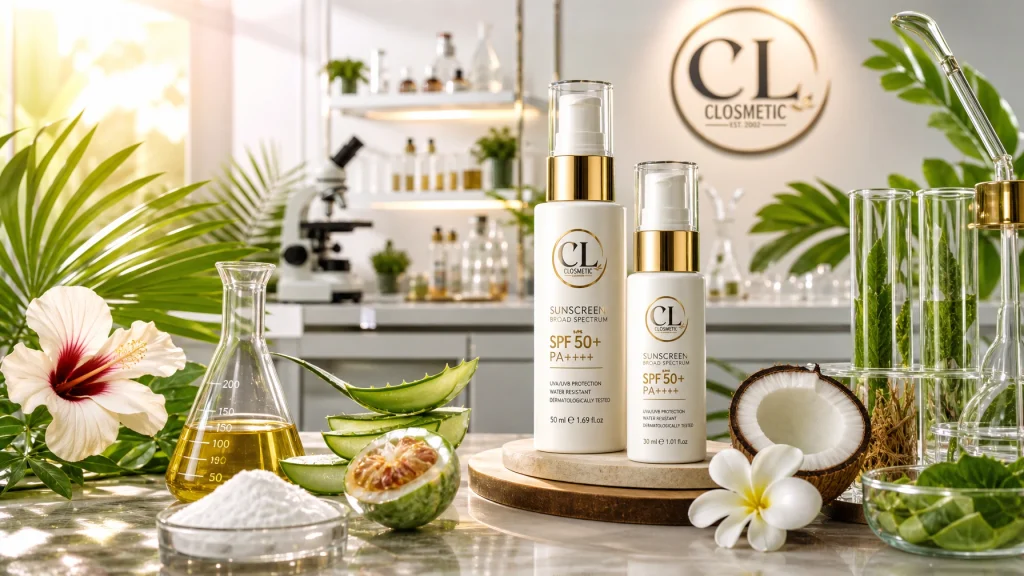
The sun protection landscape across Southeast Asia and the broader global Muslim market is experiencing a fundamental paradigm shift in 2026. Driven by tightening regulatory mandates from Malaysia’s National Pharmaceutical Regulatory Agency (NPRA) and heightened consumer awareness surrounding chemical safety, skincare brand owners face an urgent imperative: update legacy solar formulations or partner with a certified JAKIM Halal Sunscreen OEM to maintain market relevance. The demand for lightweight, daily-wear, non-comedogenic, and strictly Halal-certified sunscreens has surged across Malaysia, Singapore, Indonesia, and the Gulf Cooperation Council (GCC) member states.
Modern consumers across these tropical regions no longer tolerate greasy, heavy, or chalky sunscreens that clog pores under high heat and humidity. They demand multi-functional sun protection that delivers broad-spectrum SPF 50 PA++++ protection, blends invisibly into diverse skin tones, and functions as a high-performance skincare product. Furthermore, for Muslim consumers who represent over 60% of the Malaysian population and a growing segment in regional hubs like Singapore, assurance that every raw material and manufacturing line meets strict Shariah compliance is mandatory.
Achieving this delicate balance between chemical photostability, sensory elegance, regulatory compliance, and Halal integrity requires technical R&D capabilities that go far beyond standard cosmetic blending. Partnering with a specialized Halal Sunscreen OEM manufacturer allows beauty brand owners, cosmetic startups, and established personal care conglomerates to access advanced R&D labs, automated cleanroom manufacturing facilities, and streamlined regulatory submission workflows. Brand executives seeking deeper analytical data on market shifts can also explore our Beauty Manufacturing Insights Hub for updated industry forecasts and technical whitepapers.
2. Navigating NPRA UV Filter Compliance and Regulatory Directives
Regulatory harmonization across the Association of Southeast Asian Nations (ASEAN) via the ASEAN Cosmetic Directive (ACD) has accelerated the restriction and phase-out of traditional organic UV filters. Following international environmental studies documenting marine toxicity and coral bleaching, the NPRA has aligned its Quest3+ notification portal to enforce stricter limits on older chemical filters like Oxybenzone (Benzophenone-3) and Octinoxate (Ethylhexyl Methoxycinnamate).
For cosmetic brand owners, this regulatory shift requires a complete reformulation strategy. Continuing to distribute formulations containing legacy chemical filters exposes brands to compliance penalties, product recalls, and severe brand equity damage. A forward-thinking Halal Sunscreen OEM partner replaces compromised ingredients with next-generation, photostable UV filters that deliver superior protection without triggering safety red flags.
Key modern filters engineered into 2026 Halal Sunscreen OEM formulations include Bemotrizinol (Tinosorb S), Bisoctrizole (Tinosorb M), and Diethylamino Hydroxybenzoyl Hexyl Benzoate (Uvinul A Plus). Tinosorb S provides exceptional broad-spectrum protection against both UVA and UVB wavelengths while stabilizing weaker filters within the oil phase. Tinosorb M operates as a hybrid filter, absorbing and scattering UV radiation simultaneously within the aqueous phase. By combining these advanced organic molecules with micronized physical barriers, OEM chemists achieve target SPF 50 ratings with lower overall chemical loading, drastically reducing the potential for skin irritation.
Navigating the administrative complexity of these regulatory transitions requires specialized regulatory affairs expertise. An experienced Halal Sunscreen OEM provider manages the entire NPRA Quest3+ product notification protocol, ensuring that safety data sheets (SDS), heavy metal screening, microbial challenge results, and clinical in-vitro SPF validation reports comply fully with National Pharmaceutical Regulatory Agency standards before mass manufacturing commences.
3. Halal Sunscreen OEM Certification Architecture in SPF Manufacturing
Developing a true Halal sunscreen involves far more than placing a logo on a carton. In the context of cosmetic manufacturing, Halal integrity governs every stage of the supply chain, from the chemical synthesis of raw ingredients to equipment sanitization protocols on the factory floor. For beauty brands targeting Muslim demographics across Malaysia, Singapore, Brunei, and the GCC, securing official certification from the Department of Islamic Development Malaysia (JAKIM) provides the ultimate mark of consumer trust.
Sunscreen formulations present several hidden Halal risks. Traditional emulsifiers, solubilizers, and lipid carriers often utilize animal-derived stearic acid, glycerin, or squalene sourced from non-dhabihah animals or porcine origins. Furthermore, many chemical filter solutions utilize denatured ethyl alcohol as a solvent to dissolve crystalline UV powders, creating significant Shariah compliance hurdles during audit inspections.
“Formulating UV protection for 2026 requires balancing strict Shariah compliance with next-generation photostable filters that do not disrupt delicate marine ecosystems.”
: Dr. Farhan Azman, Senior Cosmetic Chemist & Regulatory Advisor
To guarantee absolute compliance, an established Halal cosmetic OEM partner implements a rigorous ingredient selection protocol. Animal-derived squalene is replaced with 100% plant-derived squalane extracted from olives or sugarcane. Stearic acid derivatives are strictly audited to ensure palm oil or coconut origin, verified by official Halal certificates from JAKIM-recognized international bodies. Solvent systems rely on plant-derived glycols, such as corn-derived Propanediol or bio-based Pentylene Glycol, entirely eliminating ethyl alcohol from the processing line.
In addition to ingredient safety, the manufacturing environment must meet strict halal control points. Production lines must undergo ritual cleansing (Sertu) if any non-halal material was previously processed on shared equipment. Leading contract manufacturers utilize dedicated Halal production bays equipped with automated CIP (Clean-in-Place) stainless steel mixing tanks, ensuring zero risk of cross-contamination. Brands can inspect our comprehensive private label skincare manufacturing solutions to see how Halal compliance is built into every stage of production.
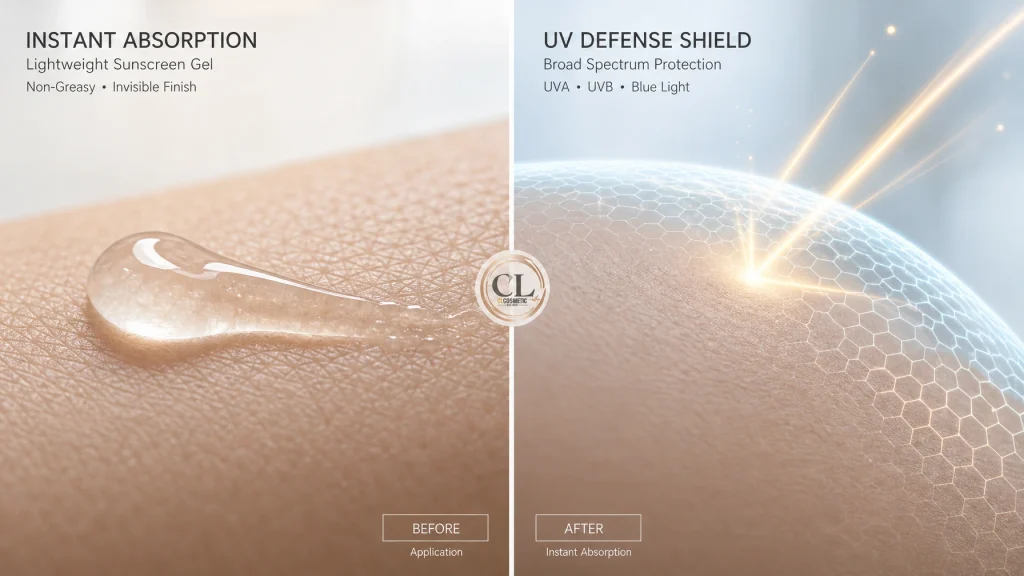
4. Engineering Zero White-Cast Mineral and Hybrid Formulations
Physical sunscreens relying on inorganic filters like Zinc Oxide (ZnO) and Titanium Dioxide (TiO2) are prized for their non-irritating nature and immediate broad-spectrum protection. However, traditional mineral formulations suffer from a major aesthetic drawback: they leave a heavy, chalky white cast on darker skin tones typical of Southeast Asian populations.
Overcoming this white cast challenge requires advanced particle engineering and surface dispersion techniques. According to research published in the Journal of Cosmetic Dermatology, raw Zinc Oxide particles reflect visible light strongly when aggregated in large clusters. When Halal Sunscreen OEM R&D teams utilize micronized, nano-sized, or polyhydroxystearic acid-coated physical filters, the particles scatter shortwave UV light while remaining virtually invisible to the human eye.
Modern OEM formulation laboratories employ two primary technical solutions:
- Surface-Treated Inorganic Dispersion: Coating Zinc Oxide particles with triethoxycaprylylsilane or jojoba esters prevents particle agglomeration in the oil phase, ensuring an even, non-streaky application.
- Organic-Inorganic Hybrid Systems: Combining lower percentages of micronized Zinc Oxide with photostable chemical filters like Tinosorb M creates a synergetic shield that provides high SPF 50+ protection while maintaining a transparent finish across all Fitzpatrick skin types.
By mastering these dispersion mechanics, OEM chemists allow brands to offer physical and hybrid sunscreens that appeal directly to consumers seeking clean, invisible protection. To understand how particle dispersion impacts product stability and sensory feel, brand owners can review our published technical articles in the CL Cosmetic Industries’ Beauty Manufacturing Insights Hub.
5. Sweat-Resistant Polymer Technology for High-Humidity ASEAN Climates
Formulating a sunscreen that maintains its protective film in the tropical heat of Malaysia and Singapore requires solving the problem of sweat-induced breakdown. Standard oil-in-water emulsions tend to emulsify when exposed to perspiration, causing the sunscreen layer to streak, run into the eyes, and wash away within minutes of outdoor activity.
To create water- and sweat-resistant sunscreens, Halal Sunscreen OEM R&D labs incorporate advanced hydrophobic film-forming polymers. Ingredients such as Acrylates/Octylacrylamide Copolymer, Trimethylsiloxysilicate, and Polyurethane-35 form an invisible, breathable, water-repellent matrix over the stratum corneum.
This polymer matrix performs three essential functions:
- UV Filter Immobilization: It anchors both oil-soluble and water-soluble UV filters evenly across the skin’s surface, preventing them from migrating into facial pores or eyes during heavy sweating.
- Breathable Moisture Barrier: It allows natural cutaneous respiration and heat regulation while blocking external moisture, humidity, and rainwater from dissolving the sunscreen film.
- Anti-Pollution Defense: The cross-linked polymer layer acts as a physical shield against microscopic airborne pollutants (PM2.5), preventing heavy metal particles and soot from adhering to the skin and triggering premature aging.
This sweat-resistant technology allows beauty brands to make long-lasting protection claims (such as 80-minute water resistance), providing a competitive edge in sports, outdoor, and lifestyle beauty markets.
6. Skincare-Infused Sun Protection: Stabilizing Actives in SPF Bases
The modern beauty market has embraced the “skinification” of sun protection. Consumers no longer view sunscreen as a stand-alone functional barrier; they expect their morning SPF to function as a high-potency anti-aging serum, hydration booster, and brightening moisturizer.
However, incorporating active skincare ingredients into a complex UV emulsion presents significant chemical stability challenges. Many potent actives, such as L-Ascorbic Acid (Vitamin C), Retinoids, or fragile peptide chains, degrade rapidly when exposed to UV radiation or react adversely with metallic Zinc Oxide particles.
An experienced ODM and/or Halal Sunscreen OEM resolves these chemical incompatibilities through specialized stabilization strategies:
- Micro-Encapsulation: Wrapping delicate actives like Retinol or Vitamin C in lipid liposomes or polymeric spheres protects them from photo-degradation and prevents premature reaction with UV filters.
- Synergistic Antioxidant Networks: Combining Niacinamide (Vitamin B3), Ectoin, and Centella Asiatica (Cica) extract creates a multi-tiered defense against oxidative stress. Niacinamide inhibits melanosome transfer to suppress hyperpigmentation, Ectoin restores cellular hydration under osmotic stress, and Cica soothes sun-induced redness.
- Fermented Bio-Actives: Utilizing Halal-certified fermented yeast and botanical extracts boosts natural antioxidant defense mechanisms without destabilizing the emulsion matrix.
By mastering these complex emulsion dynamics, OEM providers enable beauty brands to introduce multi-functional hybrid products that streamline morning skincare routines and justify premium price points. Explore our full range of custom formulation capabilities on the homepage.
7. Full-Spectrum Defense: Mitigating HEV Blue Light and Infrared Radiation
While conventional sunscreens focus exclusively on ultraviolet radiation (UVA and UVB wavelengths between 290nm and 400nm), modern dermatological research demonstrates that solar damage extends deeper into the light spectrum. High-Energy Visible (HEV) blue light (400nm to 500nm) emitted by sunlight and digital devices, alongside Infrared-A (IR-A) radiation, penetrates into the deep dermis, generating reactive oxygen species (ROS), degrading collagen matrices, and worsening melasma.
To offer comprehensive full-spectrum protection, modern Halal Sunscreen OEM formulations incorporate specialized blocking and neutralizing agents:
- Iron Oxides (CI 77491, CI 77492, CI 77499): Crucial for tinted sunscreens, iron oxides absorb and reflect HEV blue light, providing proven protection against pigment exacerbation in dark skin tones.
- Fractionated Melanin & Algae Extracts: Bio-engineered marine extracts, such as Polygonum Aviculare extract and specialized micro-algae, neutralize free radicals triggered by IR-A radiation and screen out blue light frequencies.
- Polyhydroxy Acid (PHA) Buffers: PHAs provide gentle antioxidant shielding while maintaining barrier moisture, protecting delicate cellular structures from thermal stress.
Positioning a sunscreen as a 360-degree environmental defense product allows brands to capture high-intent searches from office workers, digital professionals, and hyperpigmentation sufferers across urban ASEAN hubs.
8. Airless Packaging Systems and Shelf-Life Stabilization
The performance of an advanced sunscreen formula depends heavily on its primary packaging. Organic UV filters, botanical antioxidants, and functional emulsifiers degrade rapidly when exposed to atmospheric oxygen, ambient light, and bacterial contamination introduced by fingers.
Contract manufacturing facilities partner with leading packaging engineers to supply advanced airless pump containers, multi-layer aluminum tubes, and UV-opaque bottles. Airless pump systems utilize a mechanical vacuum piston rather than a traditional dip tube, preventing air from entering the chamber as product is dispensed.
Key packaging advantages include:
- Preservation of Active Potency: Oxygen-sensitive antioxidants like Vitamin C and Ectoin retain peak efficacy throughout their 24-month shelf life.
- Preservative Load Reduction: Minimizing air exposure allows Halal Sunscreen OEM chemists to reduce synthetic preservative concentrations, satisfying clean beauty demands.
- Precise Dosage Delivery: Airless pumps dispense a consistent volume per stroke, helping consumers apply the dermatologically recommended dose required to achieve labeled SPF protection.
- Sustainable PCR Options: Utilizing Post-Consumer Recycled (PCR) resins aligns your product line with regional environmental initiatives and eco-conscious consumer values.
9. Comprehensive Active Ingredient and Formulation Matrix
To assist brand owners in designing their customized product line, the following technical matrix outlines key ingredient selections, active usage levels, and functional benefits engineered during the Halal Sunscreen OEM formulation process:
| Ingredient Category | INCI / Active Name | Typical Usage % | Primary Functional Benefit | Regulatory & Halal Status |
| Next-Gen UV Filter | Bemotrizinol (Tinosorb S) | 1.0% – 5.0% | Broad-spectrum UVA/UVB stabilization; non-irritating | Synthetic organic; 100% Halal compliant |
| Hybrid UV Filter | Bisoctrizole (Tinosorb M) | 2.0% – 8.0% | Water-phase UVA/UVB absorption and scattering | Organic dispersion; Halal certified |
| Inorganic Mineral | Zinc Oxide (Micro-Dispersed) | 5.0% – 15.0% | Immediate physical UV deflection; non-comedogenic | Mineral origin; Halal certified |
| Soothing Active | Centella Asiatica Extract | 0.5% – 2.0% | Reduces sun-induced erythema & calms inflammation | Botanical extraction; Halal certified |
| Barrier Repair | Ectoin | 0.2% – 1.0% | Cellular osmoprotection & blue light defense | Bio-fermentation; Halal certified |
| Skin Brightener | Niacinamide | 2.0% – 5.0% | Inhibits melanosome transfer & regulates sebum | Synthetic B3; Halal certified |
| Emollient Carrier | Olive-Derived Squalane | 1.0% – 5.0% | Non-greasy biomimetic lipid replenishment | Plant origin; 100% Halal compliant |
10. End-to-End Halal Sunscreen OEM R&D and Quest3+ Notification Roadmap
Typically, executing a successful sunscreen product launch requires navigating a structured, multi-phase manufacturing process. Below is the usual commercialization roadmap executed by contract manufacturers:
[Phase 1: Concept & Briefing] ➔ [Phase 2: Custom Lab R&D] ➔ [Phase 3: Testing & Validation]
                                                                      │
[Phase 5: Commercial Production] ◄─ [Phase 4: Quest3+ & Halal Filing] ◄┘
Phase 1: Product Concept & Regulatory Scaffolding
The brand owner initiating a Halal Sunscreen OEM project specifies target SPF ratings (e.g., SPF 30 PA+++ vs. SPF 50+ PA++++), desired textures (gel, milk, cream, or tint), primary claims, and target markets. Regulatory specialists audit proposed ingredient lists against NPRA, BPOM, and HSA databases.
Phase 2: Custom R&D Lab Formulation
Chemist teams formulate initial trial batches in automated R&D cleanrooms. Emulsions undergo sensory calibration to ensure zero white cast, instant absorption, and non-tacky finishes under humid ambient conditions.
Phase 3: Analytical Testing & Clinical Validation
Laboratory samples undergo rigorous testing protocols:
- In-Vitro SPF & Broad-Spectrum Testing: Measures exact UV absorbance across 290nm–400nm spectrums.
- Accelerated Thermal Stability: Samples are stored at 40°C, 45°C, and 50°C with 75% Relative Humidity for 12 weeks to simulate 24 months of ambient shelf life.
- Freeze-Thaw Cycling: Products undergo multi-cycle temperature shifts (-10°C to +40°C) to verify emulsion integrity.
- Microbial Challenge Testing (USP 51): Verifies that preservative systems eliminate potential bacterial and fungal pathogens.
Phase 4: Halal Documentation & NPRA Quest3+ Filing
Dossiers containing raw material Halal certificates, SDS sheets, COAs, and safety assessments are submitted to the NPRA Quest3+ system. Notification numbers are granted prior to commercial batching.
Phase 5: Commercial Bulk Production & Packaging Assembly
Mass Halal Sunscreen OEM manufacturing takes place in GMP-certified cleanrooms. Vacuum emulsification homogenizers ensure particle size uniformity below 2 microns. Bulk product is transferred to automated filling lines for airless tube sealing, batch coding, and final shrink-wrapping.
Brands ready to initiate this process can submit their project brief directly via our turnkey private label skincare portal.
11. Expert Perspectives and Clinical Insights
“The primary error beauty entrepreneurs make when entering the tropical SPF market is prioritizing high SPF numbers over sensory wearability. If a sunscreen feels heavy or greasy in 85% humidity, consumers will under-apply the product, rendering the technical SPF protection useless. True Halal Sunscreen OEM innovation lies in creating invisible, water-light textures that consumers look forward to applying daily.”
: Elena Rostova, Lead Cosmetic R&D Chemist
“Navigating cross-border regulatory compliance across ASEAN requires a proactive approach. Waiting until production is completed to audit raw material Halal certificates or NPRA filter restrictions leads to costly customs holds. Integrating regulatory verification directly into the R&D stage is the only way to ensure smooth international trade.”
: Prof. Hj. Abdullah Ismail, Halal Integrity & Global Compliance Specialist
12. Key Takeaways for Beauty Brands
- Mandatory Filter Transition: Legacy UV filters are being phased out across ASEAN. Launching a competitive Halal Sunscreen line in 2026 demands transitioning to next-generation photostable organic filters like Tinosorb S and Tinosorb M or surface-coated minerals.
- Molecular Halal Compliance: Halal integrity requires strict auditing of lipid carriers, plant-derived squalane, and alcohol-free solubilizers verified by JAKIM-recognized bodies.
- Tropical Formulations: High humidity requires breathable film-forming polymer technology to prevent sweat degradation and eye stinging.
- Hybrid Skinification: Combining SPF protection with skin-brightening Niacinamide, soothing Centella Asiatica, and barrier-repairing Ectoin maximizes product value.
- Packaging Protection: Airless pump packaging preserves sensitive antioxidants from photo-oxidation and extends product shelf life.
13. Frequently Asked Questions (FAQs)
Q1: What is the typical Minimum Order Quantity (MOQ) for custom Halal sunscreen OEM manufacturing?
A: Minimum Order Quantities generally start at flexible tiers (such as 100 to 3,000 units for stock formulations and 5,000 units for fully customized bespoke formulations), depending on packaging specifications and active ingredient selection.
Q2: How long does the complete Halal Sunscreen OEM development cycle take from concept to finished product?
A: The standard timeline ranges between 12 and 16 weeks. This includes 3 to 4 weeks for lab formulation and sensory adjustments, 6 to 8 weeks for stability and microbial testing, and 3 to 4 weeks for NPRA Quest3+ notification and commercial mass production.
Q3: Can physical mineral sunscreens achieve SPF 50 without leaving a white cast on dark skin?
A: Yes. By utilizing micro-dispersed, surface-coated Zinc Oxide combined with polyhydroxystearic acid carriers, OEM chemists disperse mineral particles evenly, delivering high physical SPF 50 protection with an invisible finish.
Q4: Is ethyl alcohol required to dissolve crystalline chemical UV filters?
A: No. Advanced OEM formulation laboratories use plant-derived, Halal-compliant solubilizers like corn-derived Propanediol, C12-15 Alkyl Benzoate, and bio-based glycols to fully dissolve chemical filters without using ethyl alcohol.
Q5: What documentation is required to export manufactured sunscreens into Singapore and Indonesia?
A: Exporters require a complete Product Information File (PIF), Certificate of Free Sale (CFS), Certificate of Analysis (COA) for every batch, GMP facility certification, and a valid JAKIM Halal certificate recognized by BPJPH (Indonesia) and MUIS (Singapore).