
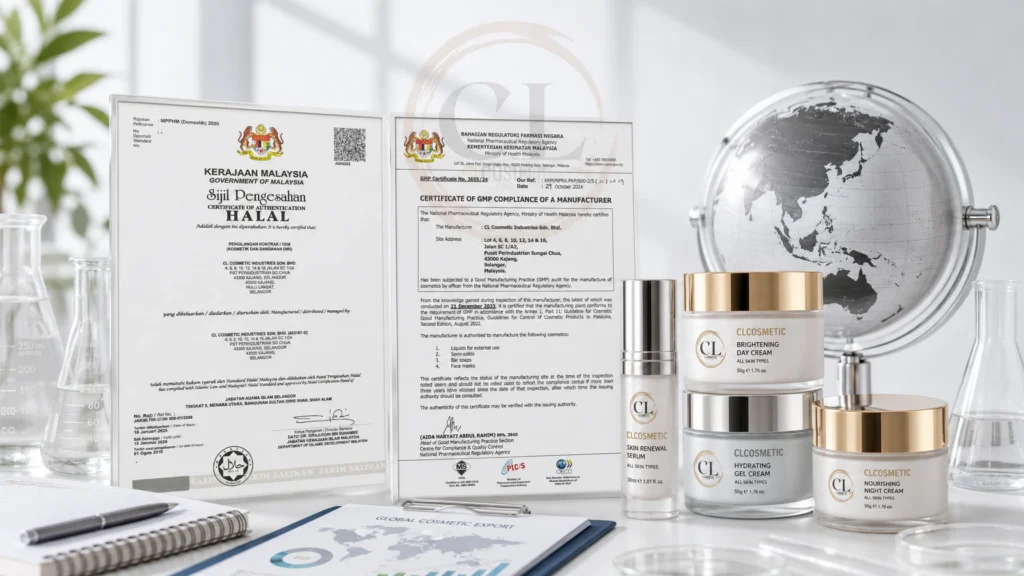
1. Navigating the 2026 Halal Cosmetics Export ASEAN Landscape
Navigating a successful Halal cosmetics export ASEAN strategy in 2026 requires navigating complex regulatory frameworks across Southeast Asia. Indonesia’s BPJPH and BPOM agencies enforce mandatory Halal compliance for all cosmetic imports.
For brands manufacturing in Malaysia, achieving synchronized compliance across JAKIM (Malaysia), BPOM (Indonesia), and MUIS (Singapore) is vital. Selecting an experienced Halal cosmetics export ASEAN OEM partner eliminates customs delays and regulatory rejections. For additional insights into cross-border regulatory trends, visit the Beauty Manufacturing Insights Hub.
2. Leveraging Mutual Recognition Agreements
JAKIM maintains Mutual Recognition Agreements (MRAs) with primary international Halal bodies, including MUIS and BPJPH.
Manufacturing in a JAKIM-certified Halal cosmetic OEM facility allows brands to streamline entry into neighboring markets across Southeast Asia. Your OEM partner provides complete raw material dossiers to accelerate localized import permits.
“Harmonizing JAKIM, BPOM, and MUIS requirements during initial OEM pilot batching eliminates expensive customs bottlenecks before cross-border shipping.”
: Prof. Hj. Abdullah Ismail, Halal Integrity & Global Compliance Specialist
3. Pre-Emptive ASEAN Cosmetic Directive Alignment
Before addressing Halal status, products must fulfill safety mandates under the ASEAN Cosmetic Directive.
A knowledgeable manufacturer builds compliant custom SPF formulations to the strictest regional standards, excluding questionable preservatives across all target export destinations.. Review the full regional safety framework on the ASEAN Official Portal. You can also explore our private label manufacturing expertise to see how CL Cosmetic Industries builds compliant formulations from day one.
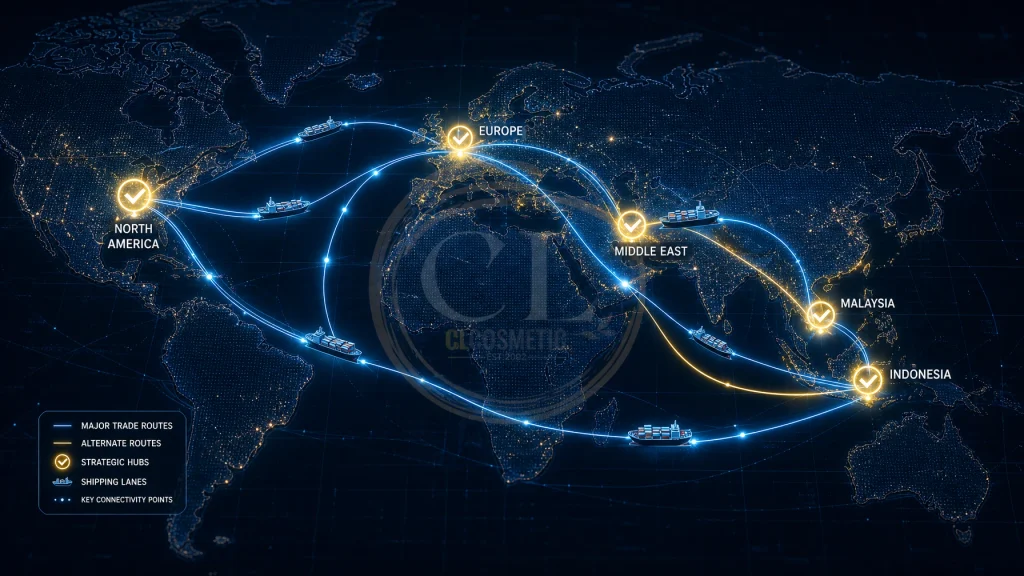
4. Raw Material Chain of Custody
Executing a compliant Halal cosmetics export ASEAN product line relies on an unbroken raw material chain of custody. Every emollient, fragrance, and active ingredient requires documented Halal origin.
Established OEM manufacturers maintain databases of pre-approved Halal ingredients complete with Certificates of Analysis (COA) to prevent regulatory holds.
5. Navigating BPOM PIK Registration
Exporting cosmetics to Indonesia requires securing product registration numbers (NIE) from BPOM.
Your contract manufacturer provides comprehensive cosmetic regulatory compliance and notification services, including stability testing and safety dossiers required for overseas filing.
6. Alcohol and Solvent Compliance Policies
While fatty alcohols like Cetearyl Alcohol are permitted, ethyl alcohol usage undergoes strict scrutiny by customs authorities in conservative markets.
Chemists from custom skincare R&D formulation labs substitute synthetic ethanol with botanical glycols like corn-derived Propanediol, ensuring compliance across all Islamic jurisdictions.
7. GMP Certification as a Baseline
Halal compliance requires a foundation of absolute hygiene, verified through Good Manufacturing Practice (GMP) certification.
Health regulators, including Malaysia’s NPRA and Singapore’s Health Sciences Authority (HSA), mandate GMP compliance. Learn more about our certified GMP manufacturing facilities to safeguard your product quality.
8. Strategic Pilot Runs and Labeling
Labeling errors are a primary cause of customs detentions during Halal cosmetics export ASEAN distribution. Indonesia requires specific language translations and local importer details on outer packaging.
Executing small-batch pilot runs through our flexible low-MOQ contract manufacturing options allows you to verify localized packaging design before full-scale regional distribution.
9. Cross-Border Regulatory Matrix
| Destination Country | Governing Regulatory Body | Halal Certification Body | Mandatory Documentation |
| Malaysia | NPRA (Quest3+) | JAKIM | CFS, COA, GMP, Halal Certificate |
| Indonesia | BPOM | BPJPH | PIF, NIE Registration, Halal MRA |
| Singapore | HSA | MUIS | Product Notification, CFS, COA |
| United Arab Emirates | MoIAT | ESMA / Halal National | Certificate of Conformity, Halal COA |
10. Step-by-Step Export Dossier Checklist
Exporting beauty products across ASEAN requires thorough documentation prepared by your OEM:
- Certificate of Free Sale (CFS): Issued by the Ministry of Health in the manufacturing country.
- Product Information File (PIF): Contains formula quantitative data, raw material MSDS, and microbial challenge testing.
- JAKIM Halal Certificate: Validated batch certificate matching export lot numbers.
- GMP Compliance Verification: Proof of facility operational standards. Access detailed guidance on CL Cosmetic’s skincare contract manufacturing services.
11. Key Takeaways
- MRA Utilization: JAKIM certification simplifies clearance with MUIS and BPJPH.
- Document Readiness: Complete PIF dossiers are essential for rapid BPOM approvals.
- Solvent Selection: Replacing ethanol with corn-derived Propanediol prevents import rejections.
- GMP Standards: Certified manufacturing facilities are mandatory for all Halal cosmetics export ASEAN trade.
12. Frequently Asked Questions (FAQs)
Q1: Does a JAKIM Halal certificate automatically allow sales in Indonesia?
A: While JAKIM is recognized by BPJPH, brands must still register product dossiers with BPOM before local sale.
Q2: What documents are required for customs clearance during Halal cosmetics export ASEAN operations?
A: Key documents include the Certificate of Free Sale (CFS), GMP Certificate, Halal Certificate, Certificate of Analysis (COA), and Product Information File (PIF).
Q3: How do OEM manufacturers ensure ingredients remain Halal during transport?
A: Certified OEMs enforce strict supply chain protocols, including sealed, tamper-evident raw material packaging and dedicated Halal logistics channels.